Why search
An app has to be found before it can be installed, and there are two ways to be found in a store: someone hands you a link, or someone types something into the search box. The first runs on ads and social, costs money and effort, and stops the day you stop. The second doesn't stop — every day you hold a rank compounds.
That's why the unit of ASO isn't installs, it's which keyword you rank for and where. Installs are the outcome; rank is what produces it.
Which fields do the stores index?
The two stores do the same job with different fields. The most common mistake is stuffing keywords into the iOS description: Apple does not read it for search.
| Field | App Store (iOS) | Google Play |
|---|---|---|
| App name | Indexed · 30 chars | Indexed · 30 chars |
| Subtitle | Indexed · 30 chars | — |
| Short description | — | Indexed · 80 chars |
| Keyword field | Indexed · 100 chars, invisible to users | — |
| Long description | Not indexed | Indexed · 4,000 chars |
| Developer name | Indexed | Indexed |
How rank is measured from outside
The store never tells you your rank. App Store Connect and Play Console show installs, conversion and (partly) which terms brought people in — but not the answer to "where do I rank for 'dream meaning' today?"
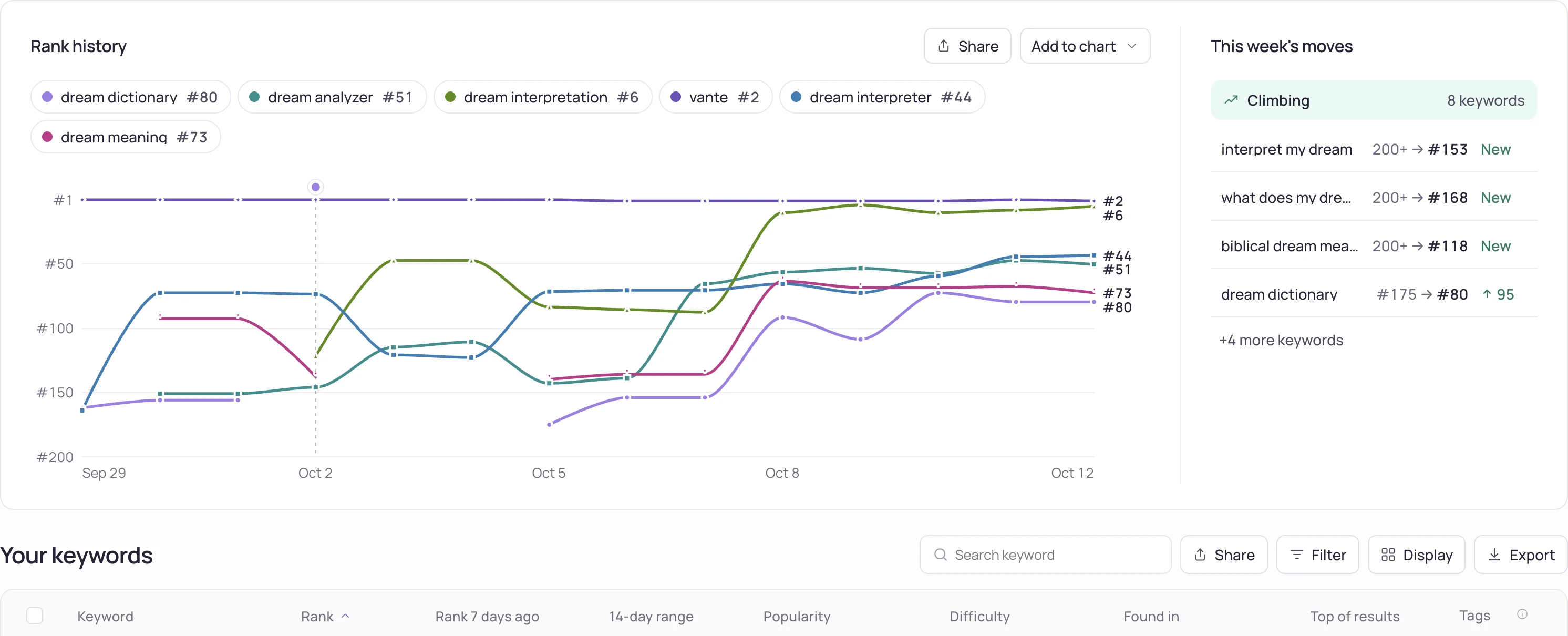
That answer is a rank tracked over time: your app's position for a term in one storefront, recorded every day. The value isn't in one day's number — it's in the difference between days.
- iOS — "not ranked" means the app was not in the results read that day, not rank zero.
- Android — Google Play ranks separately from the App Store, so read Play ranks on their own.
- Country — every storefront is its own search engine. The same term can be 3rd in one market and 80th in another; the two can't share a row.
Rank alone isn't enough: demand
Ranking first for a term nobody searches buys you nothing. So a second question sits next to every rank: does anyone search this?
The industry's standard answer to that used to be the Apple Ads "Search Popularity" score. That score largely stopped working in autumn 2025, and it never existed in every storefront to begin with. The alternative is a search demand signal: is the term searched in that storefront, and how widely. Details on its own page.
The wall has a name
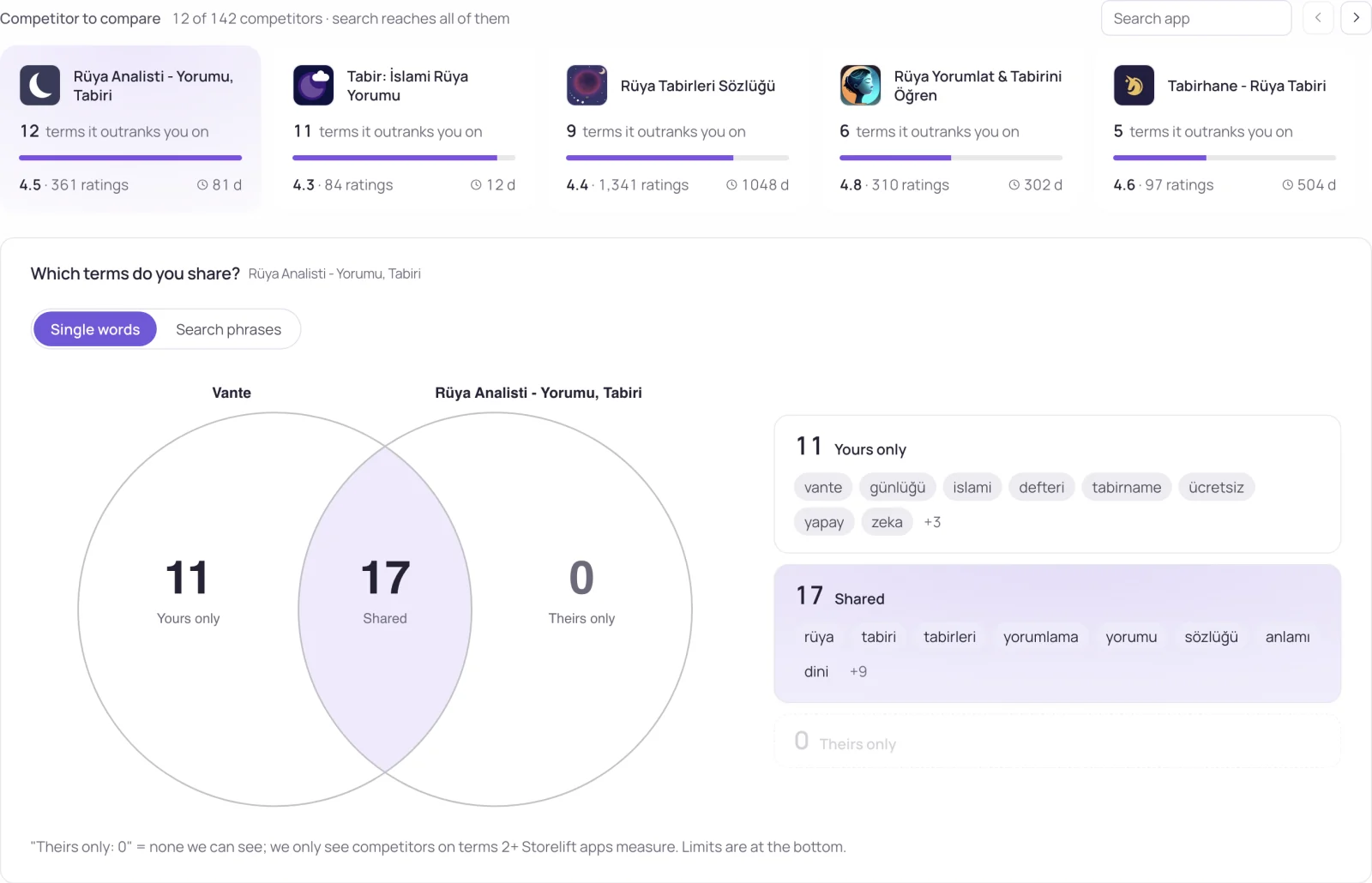
"Competition is strong" is not a measurement. The measurement is who ranks above you on that keyword: how many ratings they have, what score, how old they are. A six-year-old app with 740 ratings is not the same wall as a new one with 79 — the first is a reason to drop the keyword, the second is a reason to push.
A practical rule: for every keyword you want to climb, look at the five apps above you. If all five are older and heavier than yours, the keyword is the wrong pick — a narrower term buys a higher rank for the same effort.
What to pair the measurement with
These three questions sit outside what the stores publish:
- A term's real monthly search volume — neither Apple nor Google publishes it. Storelift shows one monthly figure per term; Hive knows it.
- A rival's installs and revenue — neither store publishes them. Storelift shows them in App Intelligence; Hive knows them.
- Personalized results — the store reorders by language, country and history. What gets measured is the un-personalized baseline.
Three things can be measured instead, and they're enough to decide with: rank, rank movement, and the strength of the apps above you.
Frequently asked
How long until ASO work shows a result?
Ranks start settling within a few days of a metadata change going live. Any sentence that promises a duration is guessing; the correct method is comparing the same keywords before and after the change — which means starting measurement BEFORE you ship it.
Should I put keywords in the app name?
The name is the heaviest field in both stores. It is also your brand: pushing a search term into it buys rank and weakens brand search. The usual balance is to protect the name and spend the subtitle (iOS) and short description (Play) on terms.
Should I track the same keywords in every country?
No. Measuring a Turkish term in the US storefront returns nothing. Every storefront needs its own list; for the same app, the TR and US lists often don't overlap at all.
How do I check my rank for free?
You can search the store by hand and count, for one keyword. Two limits: your own account sees personalized results, and a one-off number shows no movement. Storelift's free tier runs that measurement automatically every day for one app, 10 keywords per storefront and two countries.
See this for your own app
Paste your store link, add your keywords. Rank, the apps above you and demand are measured every day.
Free plan: 1 app, 10 keywords in each of 2 storefronts, 14 days of history, no card, no end date. Pro is $29/mo.
Start free →