What the screen shows
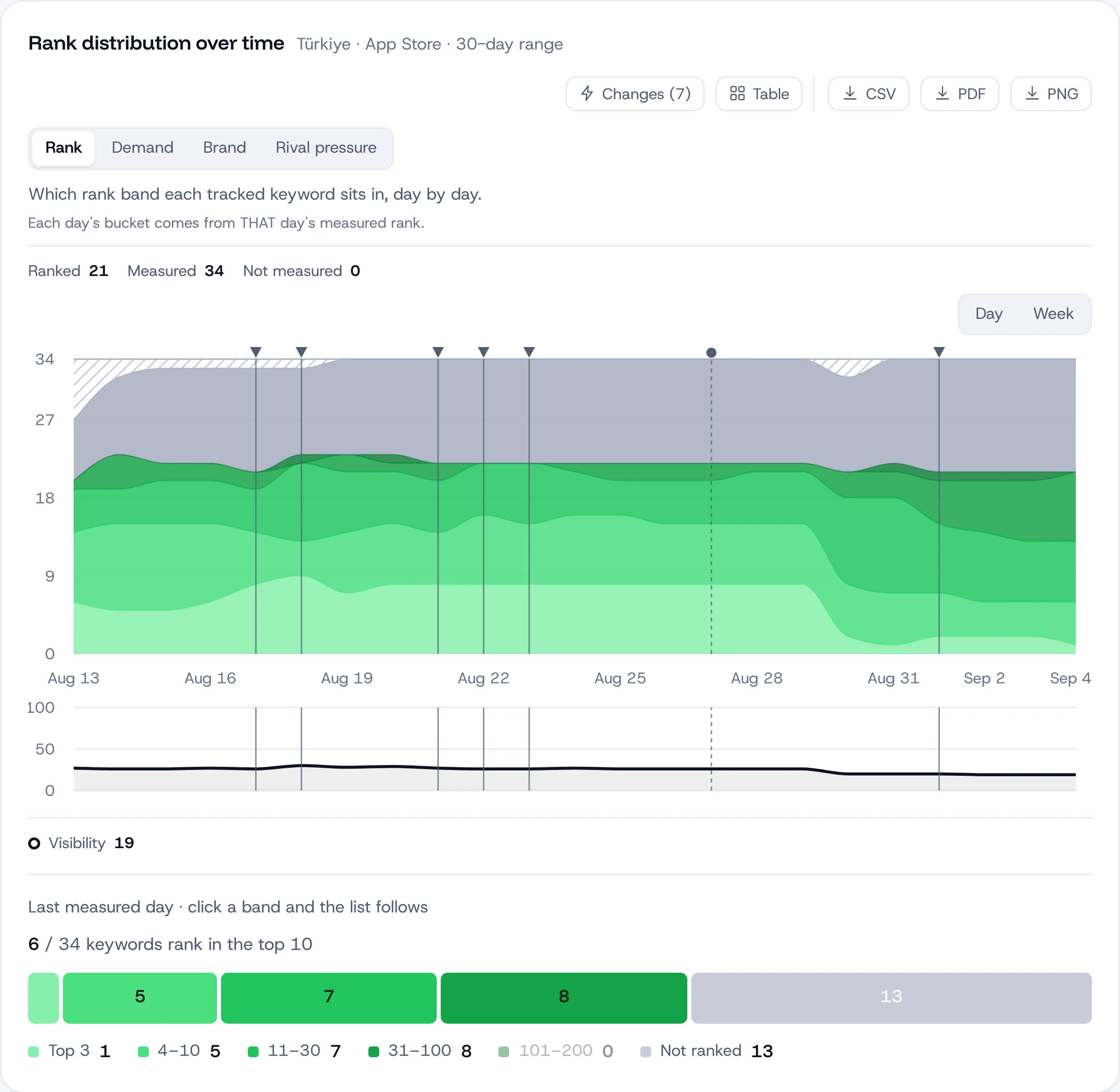
Every figure on this page is read from a code path, not written by hand — the same discipline the product applies to your own data.
What gets measured
One row per keyword per storefront. A keyword tracked in four countries is four measurements, not one — because rank in the US tells you nothing about rank in Germany, and an average of the two describes neither.
| Field | Where it comes from | Depth |
|---|---|---|
| Rank | The store's own search result for that term | App Store: first 200 · Google Play: first 30 |
| Apps above you | The same search result, in order | Name, rating score and rating count for each |
| Demand signal | Store autocomplete for that prefix | Whether the term is suggested at all, and where |
| Ratings wall | Rating counts of the apps ranked above you | Highest of the top 10, not the median |
| History | Every run is stored, per keyword and storefront | 30 days on Free, 365 days on paid plans |
How a run works
- Paste the store link. The app, its storefronts and its current listing are read from the store; nothing is typed in by hand.
- Add the keywords. Each one is paired with the countries you picked. The pair — keyword × storefront — is the unit that gets measured.
- The nightly run. One run starts at 02:10 UTC and measures about 800 units. Above that, terms rotate rather than being silently dropped.
- Re-measure on demand. After you ship a metadata change you don't wait for the night: a manual run re-measures that app immediately, within the day's quota.
Movement is pushed out, not just drawn. When a keyword moves past a threshold you set, the alert goes to Telegram, Slack or a webhook, and it is always in the dashboard's own alert list.
What you do with it
Rank, per storefront
A keyword tracked in four countries is four measurements. Rank in the US tells you nothing about rank in Germany.
See how a run worksHistory with the gaps intact
Every run is stored per keyword and storefront. A day that failed stays a gap on the chart.
Check a keyword without an accountTold when it moves
Past a threshold you set, the move goes to Telegram, Slack or a webhook, and to the dashboard's alert list either way.
Read the rank tracking guideWhat this does not tell you
A day we couldn't measure is not drawn as a zero.
Rank tracking has three possible outcomes, and most tools collapse them into two. We keep all three, on the screen and in the API:
- A number — the app was found at that position in the store's own search result.
- Not in the list (
rank: null,measured: true) — the search ran and returned results, and the app was not among them down to the depth we read. - Not measured (
measured: false) — the request failed or timed out. This is not a zero and it is not a drop. The chart leaves a gap instead of drawing a line through it.
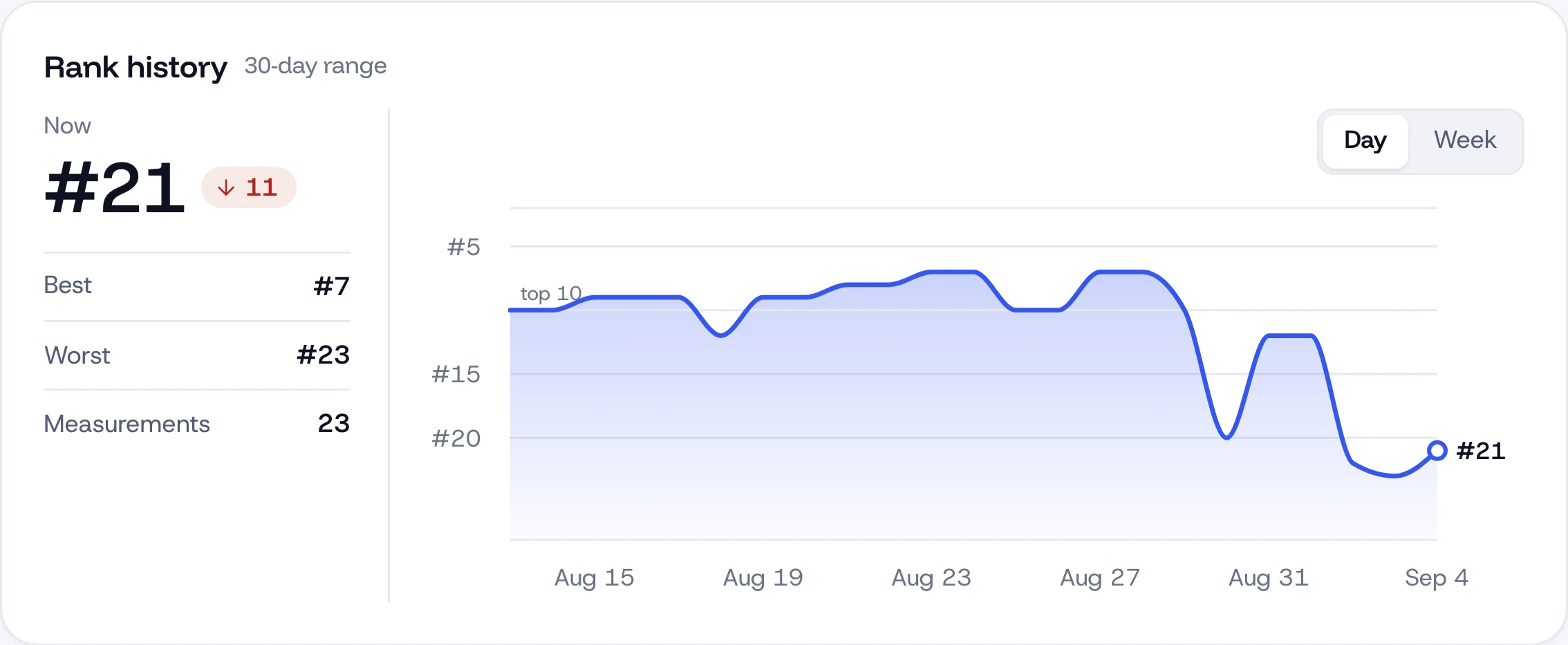
Beyond that: we read the first 200 results on the App Store and the first 30 on Google Play. Rank 340 exists, we just don't claim to know it. And a rank is a position, not a number of installs — what a position is worth depends on how many people search the term, which is a separate measurement.
What each plan includes
| Free | Pro | Studio | |
|---|---|---|---|
| Apps | 1 | 5 | Unlimited |
| Keywords per storefront | 25 | 250 | 500 |
| Storefronts | 2 | All 128 | All 128 |
| History kept | 30 days | 365 days | 365 days |
| Manual re-measures per day | 3 | 10 | 25 |
| CSV export | — | Yes | Yes |
Pro is $20/month ($18 billed yearly), Studio $60/month ($54 billed yearly). Rank tracking itself is on every plan, including the free one.
Frequently asked
How often is rank measured?
Once a night, in a run that starts at 02:10 UTC, plus any manual re-measures you trigger during the day (3 per day on Free, 10 on Pro, 25 on Studio).
How deep do you look?
The first 200 results on the App Store and the first 30 on Google Play. Past that we write "not in the list" rather than inventing a position.
What does an empty spot on the chart mean?
That the measurement failed that day. It is drawn as a gap on purpose — a failed request plotted as a zero would look exactly like losing every rank you had.
Is a keyword tracked in five countries one keyword or five?
Five. The unit we measure and count against your plan limit is keyword × storefront, because rank is a per-storefront fact.
Do I need an Apple Ads account?
No. Rank comes from the store's search result and demand comes from autocomplete. Neither needs an ads account, and both work in storefronts where Apple Ads does not operate.
See this for your own app
Paste your store link, add your keywords. Rank, the apps above you and demand are measured every day.
Start free →