01We stopped estimating what the store already prints
Google Play carries an exact install count on every listing. We were deriving that number from rating counts instead of reading it.
A rival's monthly installs, measured on Google Play
We now read the exact count Play prints on every listing and report the change between two readings — measured, not modelled. Apple publishes none, so on the App Store the figure stays a band with its arithmetic beside it.
WhereApp → Rivals → open any rival. Under Listing facts.
Rival revenue, where the chain stays tight
Installs times list price minus the store's cut; for a free app, times the paying share and the median item price Play publishes. If the band would run past tenfold, or the app lives on ads, no figure is printed at all.
WhereSame card as monthly installs. A missing line means the band was too wide to print.
Monthly search volume on the keyword table
Next to the 0–100 demand score there is now a monthly search band derived from Apple's popularity score. It is roughly threefold wide on purpose, and an empty cell means no signal — never a zero.
WhereApp → Keywords, and on the Overview table. Hide it from the Columns menu.
Add a rival by hand
Paste an App Store or Google Play address and that competitor is measured alongside the ones we found above you — including the terms where it beats you.
WhereApp → Rivals → Add rival.
The Play rating distribution, on Android
Play buries a star breakdown in its page data and we were not reading it; Reviews draws it now. Where Google publishes no block, the screen says so instead of drawing five bars at zero.
WhereApp → Reviews → Android.
How a rival earns its money
A publisher selling ad inventory through exchanges has to declare its networks in a public app-ads.txt file, so we read it and name them. A missing file is reported as missing, not as "no ads".
WhereApp → Rivals → open a rival → How it earns.
Keyword ideas for Google Play
Play publishes no autocomplete, so the Android idea list was the thinner one. It now also carries what Google search suggests to people typing your terms, marked as a separate source.
WhereApp → Keywords → Ideas, with Google Play selected.
Improved
- Three more surfaces in the API and the MCP server — The store page, reviews and chart position were on screen but not in the public API, so an assistant asking "why did my rank drop" could only see rank. All three are endpoints now, and the MCP server went from five tools to eight. Where: Settings → API keys for the endpoint list. MCP: npx storelift-mcp.
On screen
The monthly search band, next to the demand score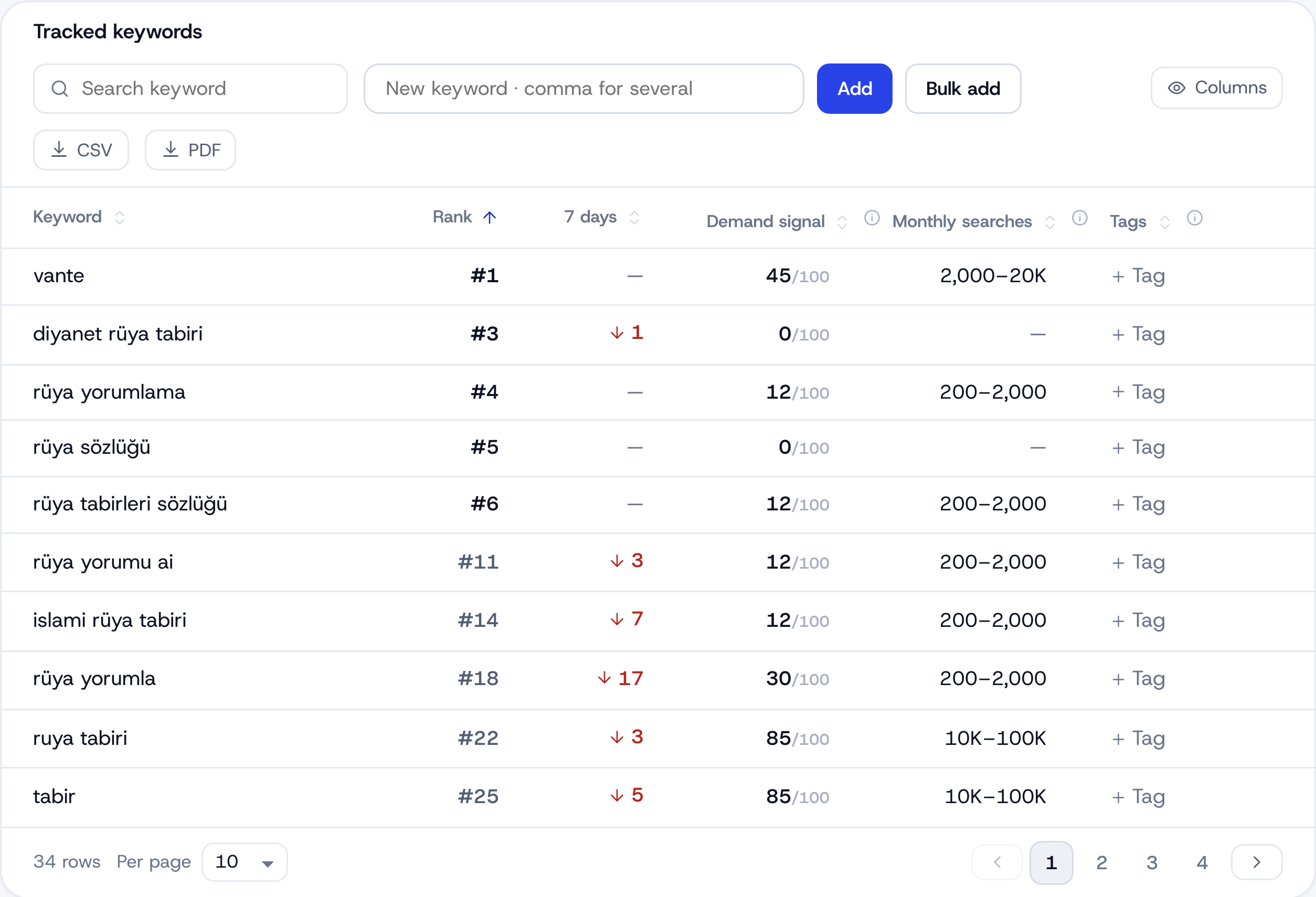
02The number Google keeps to itself, next to the rank we measure
Play Console reports, per search term, how many people reached your listing and how many installed. We had been collecting it since January and no screen read it.
Google Play's search-term acquisition, next to your measured rank
That file is now a table, with the rank we measured for the same term beside it: not "you moved to third" but "third place brought 41 visitors and 6 installs". Apple publishes no such breakdown for anyone.
WhereApp → Revenue → Play search terms.
Measure now
The endpoint, the daily quota and the remaining counter were all in place; the button was not. It now sits in the app header with the count left on it.
WhereApp → the app's own screen → Measure now.
Paste a whole keyword list — and copy it between storefronts
One per line, or split by comma, semicolon or tab; a space is not a separator, so a phrase stays one term. A list you already track can be copied to another country.
WhereApp → Keywords → Bulk add.
The date range and the storefront live in the address
A link you send now opens on the range, country and platform you were looking at, instead of the other person's defaults. A range longer than your plan's window is clamped rather than drawn empty.
WhereAny measurement screen — the address follows the selectors.
The formulas are on the screen that uses them
Difficulty, visibility, demand, monthly volume and the review gap were computed in code and explained nowhere. Each column heading now carries a mark that prints the arithmetic and says what an empty cell means.
WhereApp → Keywords — the mark next to a column heading.
Keyword tags
Group tracked keywords however you think about them and filter the table by one tag or two at once. A tag follows the keyword into every country you track it in.
WhereApp → Keywords → the Tags column, or the chips above the table.
Alert thresholds, scope and channel are yours
You now set how far a rank has to fall before you hear about it, whether alerts cover every keyword and rival or only the ones you picked, and which channel carries them. The same alert never goes to two channels.
WhereSettings → Alerts.
Improved
- Version marks on three more charts — Listing changes — a new version, new screenshots, an in-app event, an editorial placement — were only marked on the Changes screen. Overview, a keyword's own screen and Growth draw them too now. Where: App → Overview, a keyword's own screen, and Growth — under the rank curve.
Fixed
- Four screens got a door — Markets, Storefront comparison, Category and First run opened only if you typed the address; they are in the header menu now. Alongside them: changing screen returns you to the top, destructive actions ask first, and six different "saved" notes became one. Where: App → Overview → the screen menu in the header.
On screen
The Tags column, and an explanation mark on the headings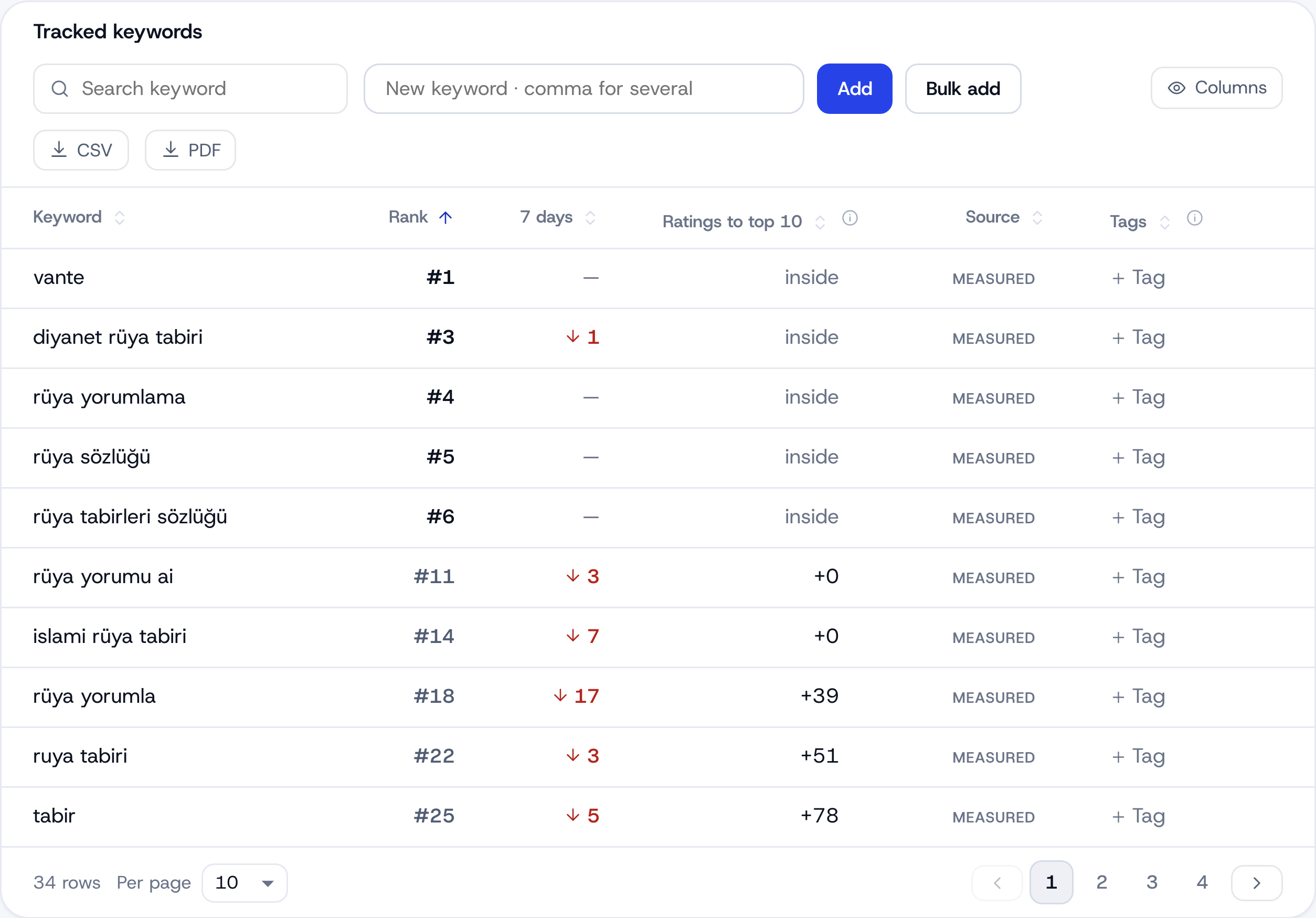
Plan limits1 row
03Five changes shipped this week
All five come from the same idea: we already measure more than we show you.
Ranks 101–200 are no longer thrown away
We search 200 positions deep but the charts stopped at 100, so a keyword sitting at 150 looked exactly like one that was nowhere. Those positions now have their own band.
WhereAny app → Keywords. The band appears in the history you already have.
The ranking chart is now a full chart
Rank distribution over time, your version and screenshot changes marked on the same timeline, and a visibility panel sharing the X axis. Click a band to filter the table under it.
WhereApp → Keywords. Export from the chart's own menu.
Visibility map
One score per country, on a map, with the table beside it. Untracked countries stay grey and unmeasured ones are hatched, so neither ever looks like a zero.
WhereApp → Markets.
Three more ways to slice the distribution
Besides rank: demand on a labelled 0–100 scale, brand keywords decided by matching real listings, and head-to-head against a rival you pick.
WhereApp → Keywords → the axis selector above the chart.
Keyword discovery
Discovery builds a candidate pool from what the measurement run already collects — autocomplete, your listing, rival listings, the similar-apps shelf — and checks where you actually rank. A candidate is one measurement: date stamp, no trend line.
WhereApp → Keywords → Discover. Promoting one counts against your keyword limit.
On screen
Rank distribution over time, with release markers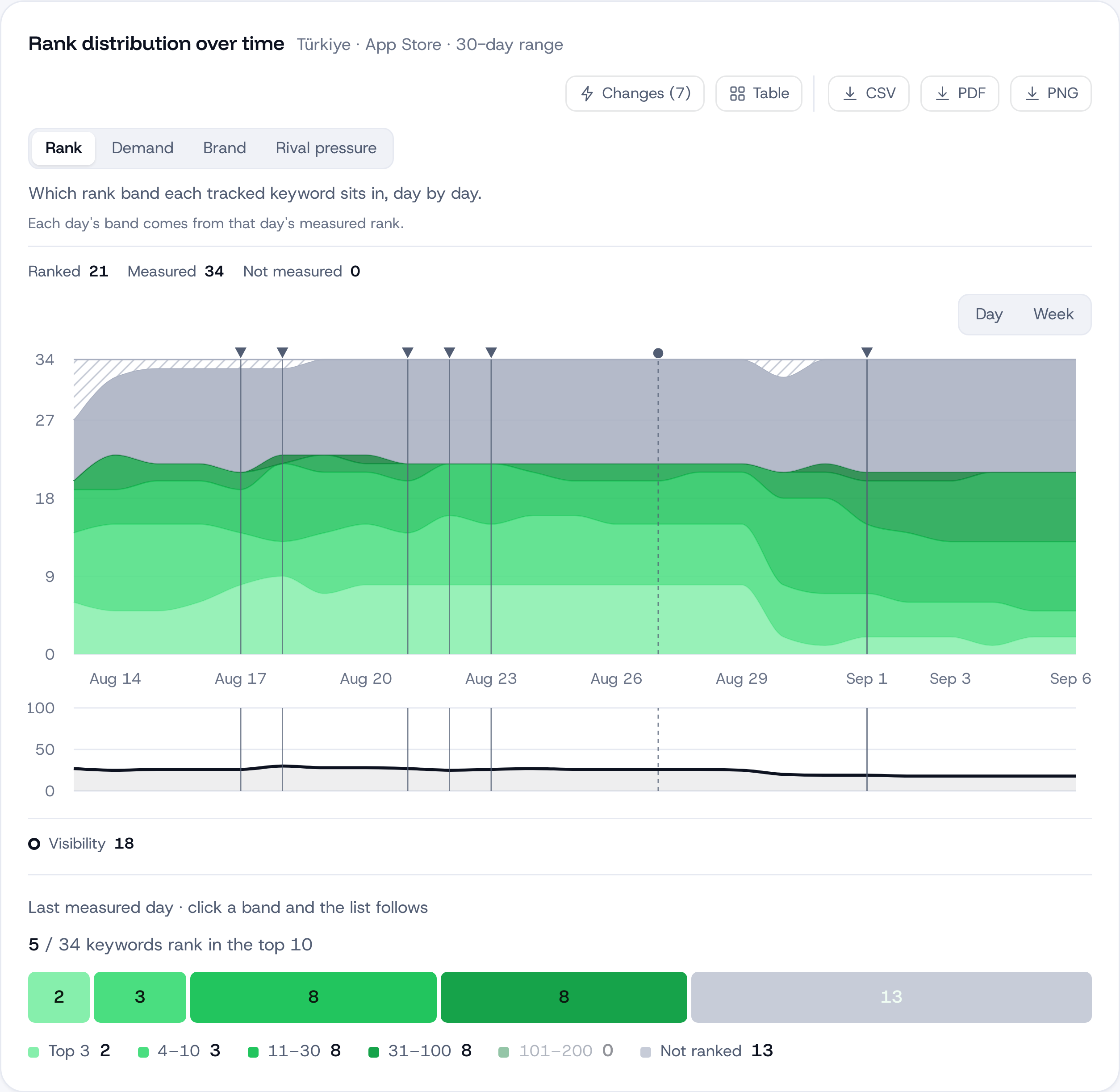
Plan limits3 rows
04What is next
What is being worked on, in order. No dates: a date that slips takes the weight out of everything else the product says.
Your own marks on the chart
We already mark version and screenshot changes; next are your own — a campaign start, a price change, a press mention.
A rival's store-page history
For a rival the only date we hold is its version date; next is when its title, subtitle and screenshots changed — usually where the explanation for a jump is.
Scheduled exports
Every table downloads as CSV, PDF and PNG today; next is the same output landing in your inbox on a weekly schedule.
Frequently asked
Can I get these by email?
Yes. If product updates are on for your account, the same text arrives by email with each release. You can turn it off in Settings.
How are versions numbered?
In sequence: v1.5 follows v1.4. It is not tied to the calendar — two releases can go out on the same day, and the date is printed next to the version anyway. The product ships continuously, so there is no upgrade step: when a release goes out it is already in your account.
See this for your own app
Paste your store link, add your keywords. Rank, the apps above you and demand are measured every day.
Start free →