"What's the best dream journal app?" used to be a search. Increasingly it is a question put to an assistant, and the answer is a short list of names. If yours isn't on it, your store ranking never enters the conversation. This is how that can be measured from outside, and what the measurement is worth.
Why store rank doesn't answer this
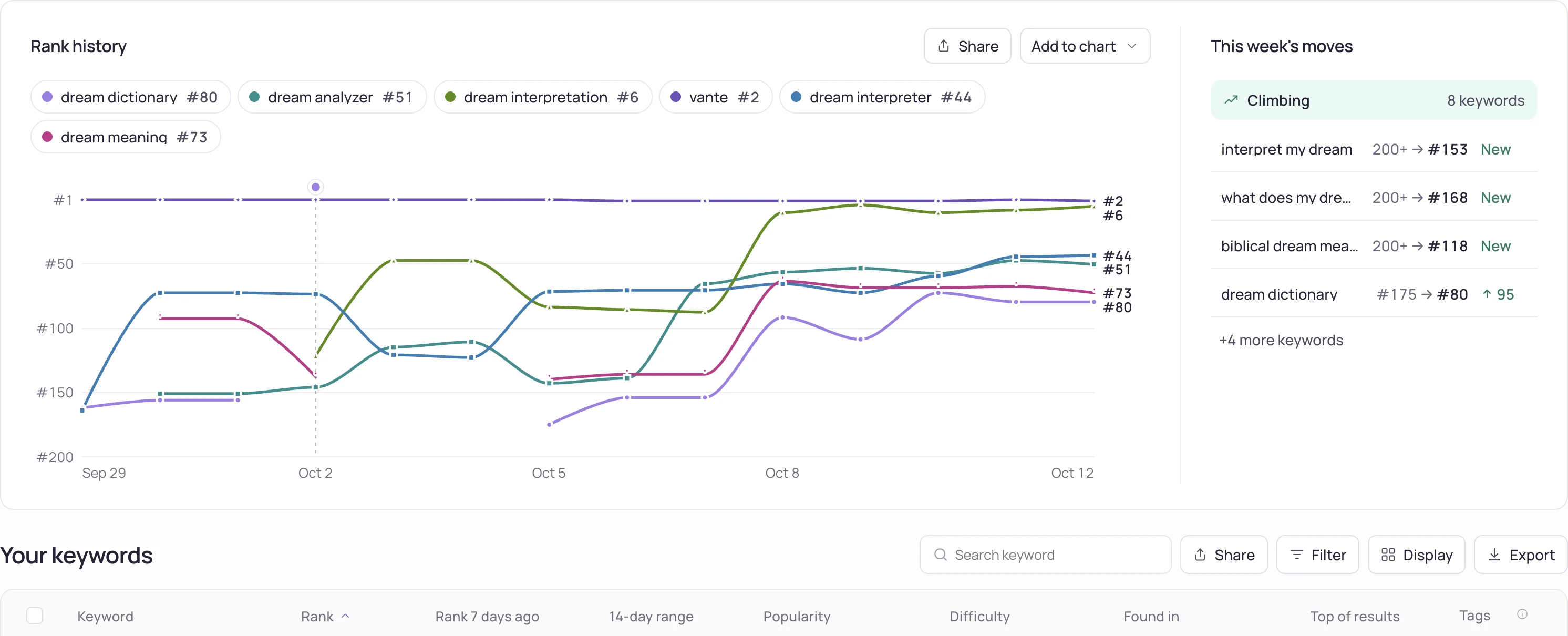
Store rank describes a result for a keyword and storefront. An assistant’s answer is a separate response to a question. Read both with their own dates and scope; one does not establish the other.
Check the original answer for your app’s identity and the other apps named. A mention or omission alone does not reveal which information influenced that answer.
How to measure it honestly
1. Ask the question a person would ask
Not "is
2. Read the answer, don't ask for a ranking
Read the original full answer and check whether the named app is yours. Keep a stated list position separate from store rank. Similar names, partial answers and ambiguous references need review.
3. Keep every answer separate
Keep each provider and surface separate. “Named by 2 of 3” combines different answers and hides their question, date and search context. Compare the original records before making a claim.
4. Record the country and the date
Record the provider, surface, question, country or language context, search setting and actual answer date. Keep the model unknown when it was not recorded; the date you save the answer is a separate field.
What one measurement proves: not much
Model outputs vary between identical calls. A single run showing your app named third proves that it can be named third, not that it usually is. This is the honest limit of the whole method and any tool that hides it is selling you noise as signal.
Compare observations only when the question set, surface and recorded context support that comparison. Variable manual question sets do not establish a trend. A change in mentions alone does not show what caused it.
A field check: 62 ASO search observations
On 24 September 2026 we recorded 27 Perplexity answers, 5 ChatGPT answers, 17 Google searches (15 produced an AI Overview), 4 Claude answers and 9 Bing organic results for general ASO tool questions. Storelift was named in one Perplexity answer, to a question about MCP servers. It appeared only as a linked source in one Google AI Overview. It was absent from the organic top ten in all 17 Google and 9 Bing result sets. The 62 observation rows include the question, surface and observed result.
Correction, 11 October 2026: the 62 rows are five different kinds of observation
The paragraph above and the data file stay as published, and nothing was measured again. The 62 rows are not 62 AI answers and do not add up to one rate.
| Surface | What was recorded | Rows | AI answers | Storelift named | Source link only |
|---|---|---|---|---|---|
| Perplexity | Answers | 27 | 27 | 1 of 27 | 0 |
| ChatGPT | Answers | 5 | 5 (1 cut short) | 0 of 5 | 0 |
| Google AI Overview | Search results with an AI Overview | 17 | 15 (none appeared for 2 searches) | 0 of 15 | 1 of 15 |
| Claude | Answers | 4 | 4 | 0 of 4 | 0 |
| Bing organic results | Search results | 9 | none: search results, not AI answers | — | — |
Each surface has its own denominator. Storelift was named in 1 of 27 Perplexity answers, and in none of the 5 ChatGPT answers, the 15 AI Overviews that appeared or the 4 Claude answers. A search that produced no AI Overview is not a zero, and the data file has no column for it: in those 2 rows the storelift_named column reads false, like the others. The 9 Bing rows are search results, so they do not belong in a count of AI answers. Added together the rows make 62, but that sum is not a rate. The note above counts two ChatGPT answers that rendered only partly: 1 is among these 5, and the other answered a brand check that is not among the 62 rows.
“Top ten” means the results that were recorded. The 17 Google result lists held 8 to 10 results each, and 4 of the 9 Bing pages showed only 2 to 6. Storelift was in none of the recorded results.
Who else measures this
As of August 2026, one competitor in the ASO category ships an AI-visibility product: AppTweak launched it in April 2026 with a taxonomy of 1,200+ user intents across 200+ subcategories, running thousands of prompts weekly. It sits on the Enterprise tier — on Essential, Grow and Grow Plus it is listed as sold separately.
Two details are worth knowing before comparing. Its own pages disagree on engine coverage: the press release and product page describe ChatGPT, while the page written for AI crawlers says ChatGPT and Claude. And across all three pages, no country or language coverage is stated — which for a measurement that changes with market is the number you would want first.
See AI visibility for what a Storelift result shows and which plans include it.
How to check your app's visibility in ChatGPT
You can run the same method by hand in any assistant. Keep it small and repeatable:
- Turn tracked keywords into open questions. "What's the best app for keyword?" — one question per keyword you already track in the store.
- Ask in a fresh session, in the market's language. A chat with saved memory or earlier turns about your app is not a neutral reading.
- Write down four things: whether your app is named, its position among the names, which apps are named instead, and the engine, country and date.
- Keep each provider and surface separate. Variable manual question sets do not establish a trend. A changed answer alone does not establish its cause.
Read the original answer alongside its recorded context. Storelift’s AI visibility page explains what each result shows.
Keep your app’s public description accurate
Make it clear what your app does and which claims a reader can verify. These practices support accurate public information; they do not guarantee an assistant mention:
- State the problem your app solves. Use concrete features and verifiable examples.
- Keep your site and store description current. Publish accurate access, price and platform information.
- Keep evidence with claims. A dated observation should retain its source, scope and limitations.
Whether an assistant's crawler reads your site at all can be checked in your own access log — the method is on does ChatGPT recommend apps.
Frequently asked
What is AI visibility for an app?
Whether an assistant names your app when someone asks it an open question in your category — "what's the best app for X" — and where your name falls among the names it lists. It is a different measurement from store search rank, produced by different machinery, and the two can disagree completely.
Can you optimise for ChatGPT the way you optimise for the App Store?
An assistant answer and a store result are separate observations. Keep your public information accurate and inspect dated answers; no listing edit guarantees a mention or establishes why an answer changed.
Do different assistants give the same answer?
Answers can differ. Record the provider, surface, search setting, question and date. Being named in one answer and absent in another does not identify what either provider has indexed or learned.
Does asking an assistant about my app affect its answers?
Keep account settings and provider policies with the observation. A chat response does not tell you whether a provider retains or later uses that interaction. Repeated questions may also change the session context; compare clearly recorded conditions.
How do I check if ChatGPT recommends my app?
Ask the open question you want to examine and keep the original answer with its provider, surface, settings, app identity and actual answer date. A single response does not establish a recommendation rate, and variable manual question sets do not establish a trend.
How can I improve my app's visibility in ChatGPT?
Publish clear, accurate information about your app and keep claims verifiable. Those actions do not guarantee that an assistant will name it. Inspect the actual answers and retain their context before making a visibility claim.
Does a high App Store rank make ChatGPT name my app?
A store rank does not establish what an assistant will answer. Examine the answer separately with its question, source, settings and date; a mention or omission alone does not reveal its cause.
See this for your own app
Paste your store link, add your keywords. Rank, the apps above you and demand are measured every day.
Free plan: 1 app, 10 keywords in each of 2 storefronts, 14 days of history, no card, no end date. Pro is $29/mo.
Start free →