What the screen shows
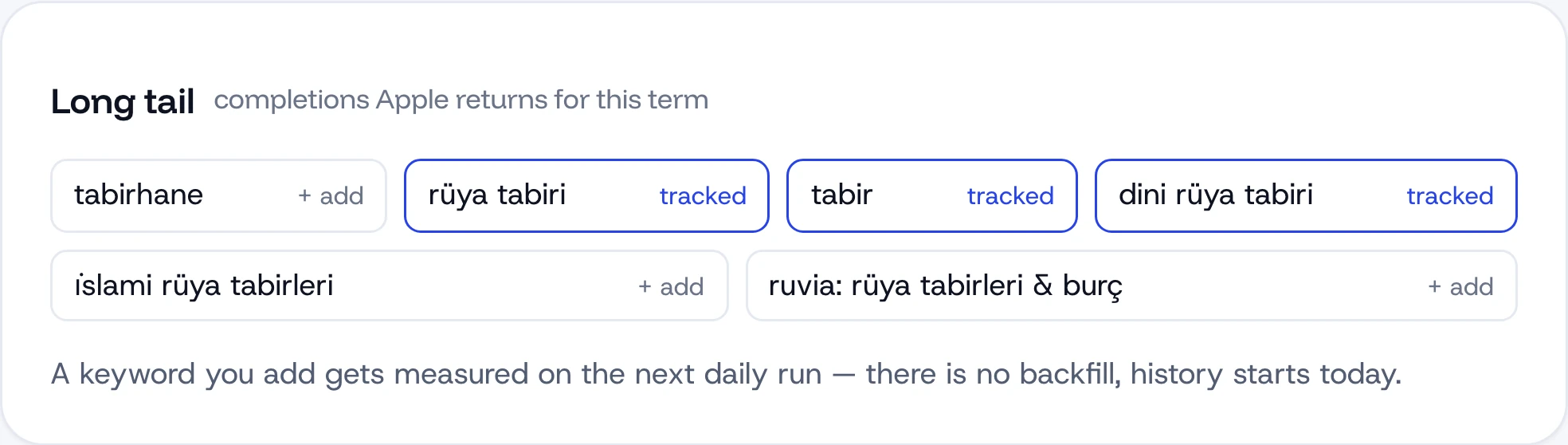
Every figure on this page is read from a code path, not written by hand — the same discipline the product applies to your own data.
Where candidates come from
Four sources, all of them already collected during the nightly run. Generating candidates costs the stores no extra requests — the data was being thrown away.
| Source | What it is | Why it is evidence |
|---|---|---|
| Autocomplete | The store's own suggestions for a prefix | A suggested term is a term people actually type |
| Your metadata | N-grams from your title, subtitle and description | Words you already target, whether you meant to or not |
| Competitors | Names and titles of the apps ranked above you | A word in a competitor's title is a targeted word |
| Similar apps | The store page's own "similar apps" shelf | The store's own view of your neighbourhood |
Every candidate carries its source. You are never asked to trust a number without being told where it came from.
How it works
- Candidates are assembled from the four sources above, for the app and storefronts you already track.
- Each candidate is measured once — a single search, a single rank reading, on the day it was generated.
- You promote what is worth keeping. A promoted candidate becomes a tracked keyword and starts collecting history from that point on.
What you do with it
Find the accidental wins
Terms you already rank well for without ever targeting them — the cheapest ranks you will get.
Pack a 100-character fieldRead the competition's intent
Words that keep appearing in the titles above you are words someone paid to choose.
See who is standing above youBuild from what you have
Candidates feed straight into the keyword field, where the constraint is space, not ideas.
Combine the words you already ownWhat this does not do
No store publishes search volume, so neither do we.
A candidate carries the demand signal from the store's own autocomplete — whether the term is suggested at all, and where. It does not carry a monthly-searches number, because there isn't one to read.
- A candidate is measured once, on the day it is generated. No history, no trend, and the screen carries a “single measurement · date” stamp.
- The long tail in store search is thin: a term the store never suggests is usually a term nobody types.
- The three measurement states apply here too — a candidate that could not be measured says so, rather than showing up as unranked.
And the three measurement states apply here too — a candidate that could not be measured says so, rather than showing up as unranked.
What each plan includes
| Free | Pro | Studio | |
|---|---|---|---|
| Discovery runs | — | 1 per week | 3 per week |
| Keywords you can promote into tracking | 25 | 250 | 500 |
| Candidate source labels | — | Yes | Yes |
Pro is $20/month ($18 billed yearly), Studio $60/month ($54 billed yearly).
Frequently asked
Where do the candidate keywords come from?
Four sources collected during the nightly run: store autocomplete, n-grams from your own metadata, the titles of apps ranked above you, and the store page's similar-apps shelf. Each candidate is labelled with its source.
Do candidates have rank history?
No. A candidate is measured once, on the day it is generated, and the screen says so. History starts only after you promote it into a tracked keyword.
Do you show monthly search volume?
No. Neither store publishes search volume. We show whether the store's own autocomplete suggests the term and where — a signal we can actually measure.
Is discovery available on the free plan?
No. Discovery runs are on Pro (one per week) and Studio (three per week). Rank tracking itself is on the free plan.
See this for your own app
Paste your store link, add your keywords. Rank, the apps above you and demand are measured every day.
Start free →