What the screen shows
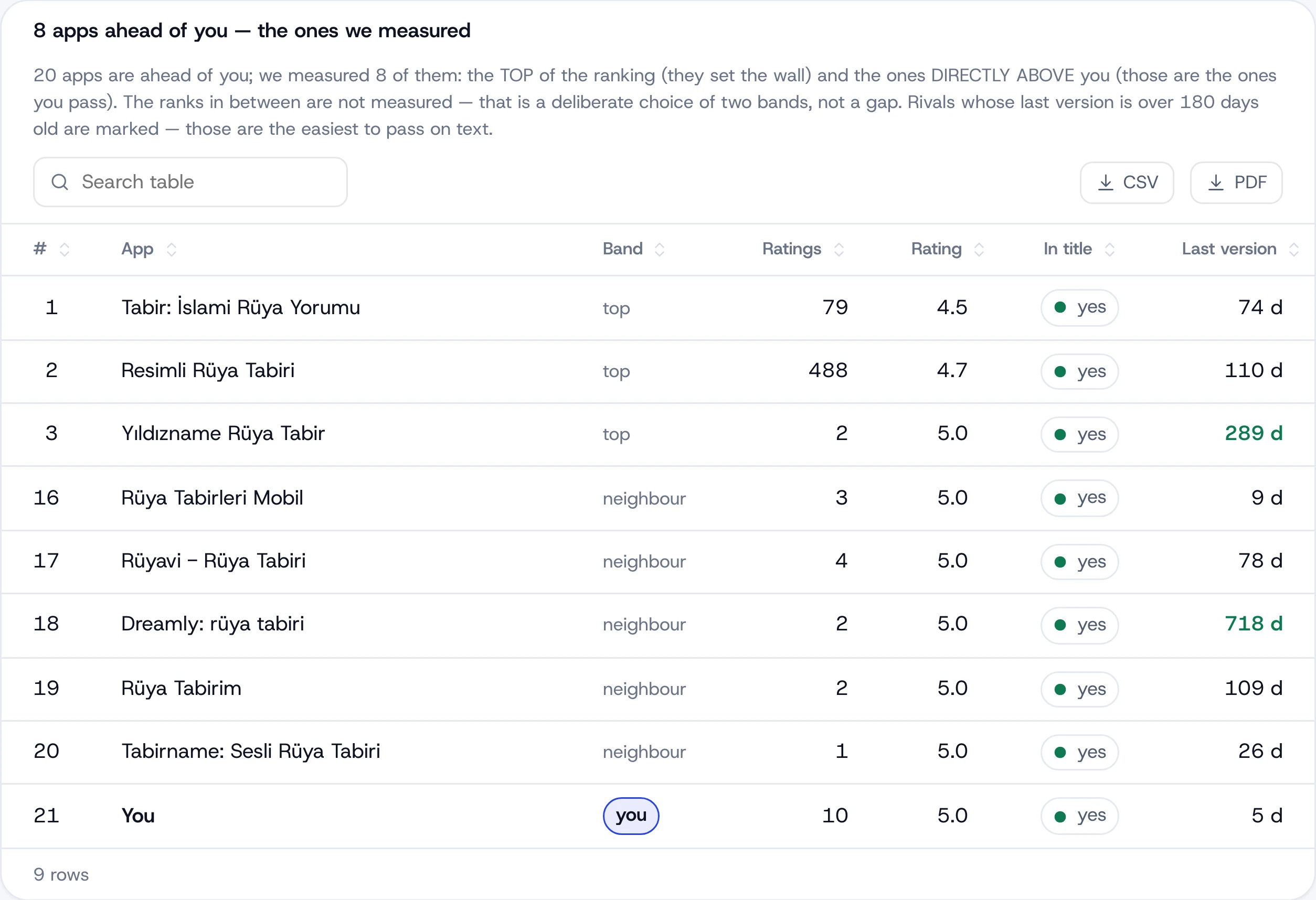
Every figure on this page is read from a code path, not written by hand — the same discipline the product applies to your own data.
What gets measured
| Field | Where it comes from | What it answers |
|---|---|---|
| Who is above you | The search result for that term, in order | Not "a competitor" — a competitor on this word, in this country |
| Ratings wall | Rating counts of the apps ranked above you | How much social proof stands between you and the first page |
| Overlap | Shared keywords across the terms you both rank for | Whether they are a rival or just in the same category |
| Listing changes | Their store page, read on a schedule | When they changed their title, subtitle, screenshots or description |
| How they make money | Ad SDKs and purchase types declared in the listing | Whether they live on ads, subscriptions or both |
How it works
- Rivals are discovered, not typed in. Every nightly measurement records the apps ranked above you, term by term and storefront by storefront.
- They are profiled. A rival that keeps appearing gets a profile: their listing, their rating trajectory, the terms you share.
- Changes are dated. When a tracked rival edits their store page, the difference is kept with the date it was seen.
- You can pin your own. A competitor you care about can be tracked deliberately, whether or not they out-rank you today.
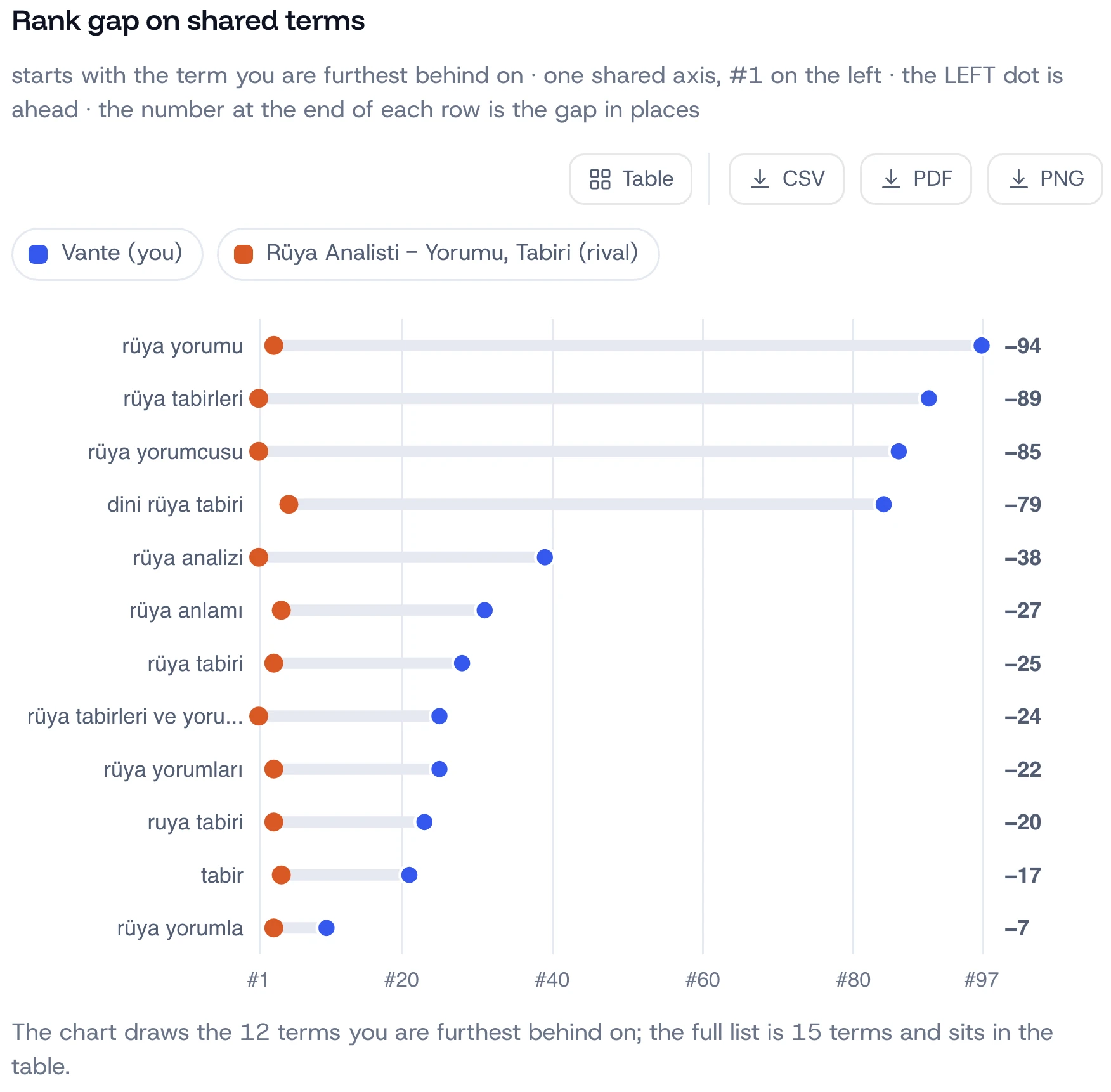
The keywords you actually share
A rival in the same category is not a rival. A rival is an app standing between you and a term you want — and the overlap view shows exactly which terms those are, with the rank difference on each one.
Read the definitionWhat you do with it
Pick winnable keywords
A wall of 200 ratings and a wall of 400,000 are not the same opportunity, however similar the rank looks.
See how many ratings it takesCatch abandoned leaders
An app that has held the top spot for two years without touching its listing is the softest target in the result.
Understand competitor overlapStrip the brand noise
Half a rival's keywords are their own brand. Those are not a market you can enter.
Filter brand terms out of a listWhat this does not do
Nobody outside the company can measure their downloads. So we don't print a number.
Everything on this page is public store data, read the way a user would see it:
- No download or revenue estimates. A number with a confidence band is still a guess wearing a suit.
- No ad creative library. We measure store search, not ad networks.
- No competitor score. “37 competitors” is not a fact you can act on. A named app standing above you on a named term is.
- Nothing from behind the listing. If a user cannot see it, neither can we.
What each plan includes
| Free | Pro | Studio | |
|---|---|---|---|
| Apps ranked above you, per keyword | Yes | Yes | Yes |
| Ratings wall | Yes | Yes | Yes |
| Storefronts compared | 2 | All 128 | All 128 |
| Rival history | 30 days | 365 days | 365 days |
| Brand-term filtering | — | — | Yes |
Pro is $20/month ($18 billed yearly), Studio $60/month ($54 billed yearly).
Frequently asked
How are competitors chosen?
They are not chosen. Every nightly measurement records which apps ranked above you on each term in each storefront, and those are your competitors on that term. You can also pin apps you want tracked deliberately.
Do you estimate a competitor's downloads or revenue?
No. Those cannot be measured from outside the company, so we do not publish a number for them.
Why show the highest rating count instead of the median?
Because the highest is the one that actually blocks you. A median describes a middle nobody has to beat.
Can I see when a competitor changed their store page?
Yes. Tracked rivals' store pages are re-read on a schedule and the differences are kept with the date they were seen.
See this for your own app
Paste your store link, add your keywords. Rank, the apps above you and demand are measured every day.
Start free →