What Apple confirms itself
Apple's own developer documentation states: "Search results are based on a number of factors, including text relevance (matches for your app's title, subtitle, keywords, and primary category), as well as user behavior (downloads, ratings and reviews, and more)."
- Text relevance — title, subtitle, keyword field, primary category.
- User behavior — downloads, ratings and reviews.
- "and more" — Apple states additional factors exist without naming them.
What Google Play confirms itself
Google Play Console's own help page states apps are ranked on "a combination of ratings, reviews, downloads, and other factors," and that search "factors in the overall experience of your app based on user behavior and feedback." The same page states directly: "the details of these weights and values are a proprietary part of the Google search algorithm."
What to do with what isn't published
Both stores let you check the MEASURABLE side of the named factors: you control what the text fields say, you can measure rating/review counts against competitors, and you can track your own rank over time. Following the named factors with the measurement you do have is a more reliable footing than guessing at an unpublished weight.
- For the text fields, see the keyword field's own page.
- For where rating count sits against competitors, see how many reviews to rank.
- For tracking your own rank over time, see App Store keyword rank tracking.
App Store vs Play Store ranking algorithm, side by side
| Factor | App Store (Apple names it) | Google Play (Google names it) |
|---|---|---|
| App name / title | Yes — text relevance | Yes — title guidance in Play Console Help |
| Subtitle / short line | Yes — text relevance | Not named |
| Keyword field | Yes — 100 hidden characters | No such field |
| Description | Not named for search | SEO best practices within spam policy |
| Category | Primary and optional secondary category are indexed | Not named |
| Downloads | Yes — user behavior | Yes |
| Ratings and reviews | Yes — can influence rank | Yes |
| Overall experience, updates | "and more" — unnamed | Yes — user behavior and feedback; regular updates recommended |
| Published weights | No | No — "proprietary" |
How to improve App Store ranking
Every step below acts on a factor Apple names itself. None of them guarantees a position; each one removes a reason not to rank.
- Put your target terms where Apple indexes text. The app name (30 characters), subtitle (30) and keyword field (100). Apple also indexes your primary and optional secondary category, so pick the most relevant ones.
- Stop wasting the keyword field. Apple's own guidance: don't repeat words from your name, subtitle or category, skip plurals of words you already have, and leave out filler and generic terms such as "app" or "game".
- Target terms you can win. Look at the apps already ranking and how established they are; a new app rarely moves a term held by an app with hundreds of thousands of ratings. Method in App Store keyword research.
- Earn ratings and reviews. Apple says they "can influence how your app ranks in App Store search". Ask through the system rating prompt at a moment the user has just succeeded — see review and rating strategy.
- Localize per storefront. Each country ranks separately and reads its own localization — see App Store rankings by country.
- Measure before and after each change. Record rank per term per storefront, change one field at a time, and compare the same measurement over the following days.
How to improve Google Play store ranking
- Write a focused title. Google asks for a title that is unique, avoids common terms and reinforces what the app is about; long titles may be shortened on some devices.
- Use the description. Play has no keyword field, so the short and full description carry your terms — Google's help asks for SEO best practices there, within its spam and IP policies.
- Improve the experience users report. Google says search factors in the overall experience of the app based on user behavior and feedback, and recommends regular updates.
- Encourage ratings and comments. Google lists this among its own recommendations, alongside ratings, reviews and downloads as ranking inputs.
Play ranks separately from the App Store, so a Play rank is read on its own, not against an iOS one — see Google Play rank tracking.
Frequently asked
Does Apple or Google publish the actual ranking weights?
No. Both name some of what affects ranking, neither publishes the weight or exact formula — Google's own documentation states outright that this is "proprietary."
Does the list of ranking factors change over time?
Yes, both stores can update the ranking system and their own documentation. This page reflects what each store currently publishes; the source links go straight to the page, so you can check the date yourself.
Does Storelift reverse-engineer the ranking algorithm?
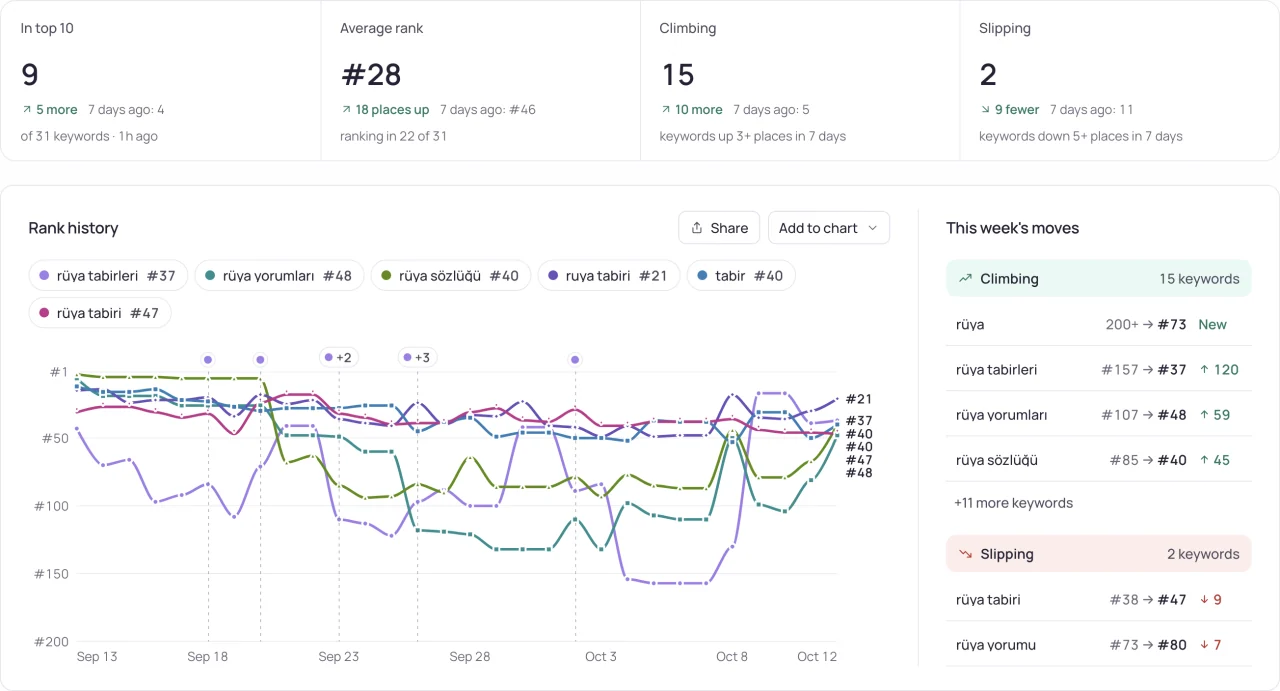
Storelift MEASURES rank — which position you hold for which term, how it's changed over time, where competitors sit. You base the decision on a measured series; the factors on this page come from the stores' own documentation.
How does the App Store ranking algorithm work?
Apple states that search results are based on text relevance — matches for the app's title, subtitle, keywords and primary category — and on user behavior, including downloads, ratings and reviews, "and more". Apple does not publish the weights or the remaining factors.
What are the Google Play ranking factors?
Google names ratings, reviews and downloads, plus the overall experience of the app based on user behavior and feedback, and "other factors". It states that the weights are a proprietary part of its search algorithm.
How can I improve my App Store ranking?
Work on the factors Apple names: put target terms in the name, subtitle and keyword field without repeats, choose relevant categories, target terms whose top-10 apps you can compete with, earn ratings through the system prompt, and measure rank per term before and after each change.
Do app updates improve Google Play ranking?
Google recommends maintaining and improving the app through regular updates as part of building a good experience, which it factors into search. It does not say an update alone moves rank.
See this for your own app
Paste your store link, add your keywords. Rank, the apps above you and demand are measured every day.
Free plan: 1 app, 25 keywords in each of 2 storefronts, 30 days of history, no card, no end date. Pro is $20/mo.
Start free →