Investigation steps
- Record the app identifier, platform, country, exact term and last successful observation. A recent dashboard refresh does not necessarily mean the underlying observation is recent.
- Inspect the measurement status before the rank. Keep unsuccessful observations out of before-and-after averages; they do not represent a rank of zero or a fall to last place.
- Compare other terms in the same collection window. A gap across many unrelated terms suggests a collection issue to investigate; one successful search without the app calls for a visibility investigation instead.
Worked interpretation
Illustrative case: Monday has rank 12, Tuesday has a failed observation and Wednesday has rank 13. Report two observed ranks and one missing day. The evidence does not establish a Tuesday decline or recovery.
Decision and next check
Keep a record of the affected scope and the next successful measurement. Escalate a repeated collection gap with those identifiers. Resume visibility comparisons when comparable observations exist; do not fill the missing date with an invented rank.
Related Storelift feature
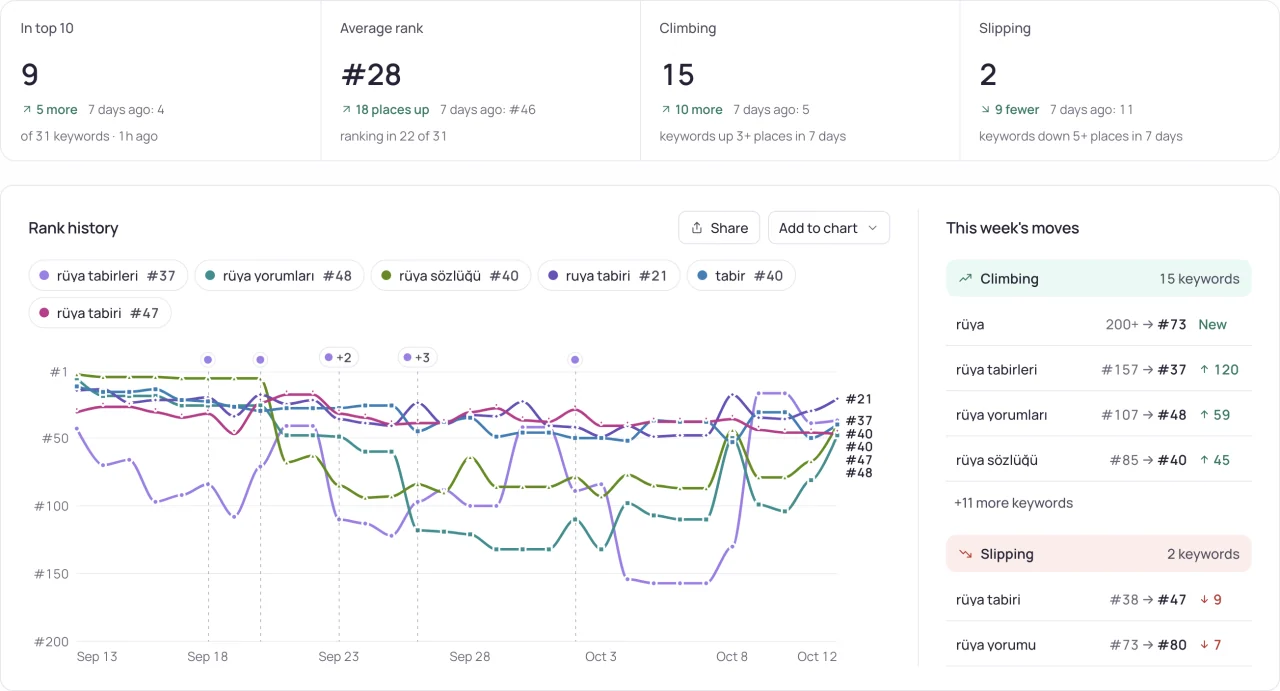
Read App rank tracker for the available product data and its scope. Keep the app, storefront, period and measurement status with the observations used in your report.
Example output
| Keyword | Result |
|---|---|
| sleep sounds | Measured, not in the results |
| white noise | #57 |
The free rank check gives the same reading for one keyword of your own app.
Read the same result from your own code: API reference: keyword ranks · MCP server
Check your keyword rank now
The free rank check reads one keyword rank for your app in the storefront you pick, on the App Store or Google Play, and lists the apps above you.
Check a keyword rank →- How the keyword rank is measured
- Plans that track your keyword rank every dayFree: 25 keywords in each of 2 storefronts. Pro: 2,500 tracked keywords in every storefront.