What the screen shows
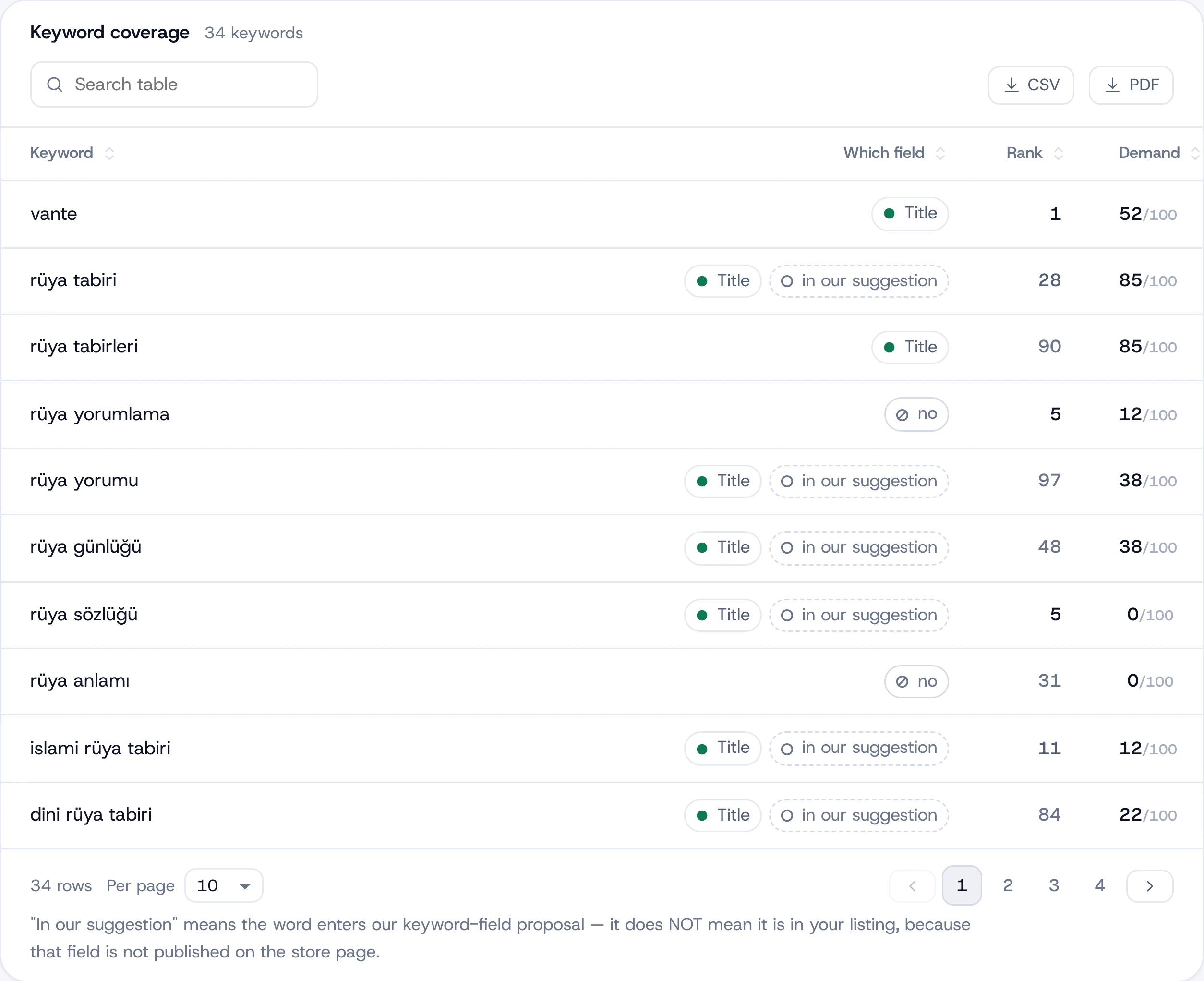
Every figure on this page is read from a code path, not written by hand — the same discipline the product applies to your own data.
Three screens, three questions
| Screen | The question it answers | What it is |
|---|---|---|
| Your text | Which of my tracked keywords does my listing already cover? | An audit — term by term, field by field |
| Gap to text | Which uncovered term fits into which slot? | A placement — with the remaining character budget per field |
| Draft | What do I write in that slot? | A production step, measured terms in hand |
Splitting them is deliberate. In one screen it is too easy to start placing words before you have read the audit — and when the budget is a hundred characters, the order of those two steps decides what gets left out.
How it works
- Your listing is read from the store, per storefront, in the language that storefront actually serves.
- Tracked terms are matched against the fields. A term can appear in the title, the subtitle, the description, or nowhere — and "nowhere" is the interesting column.
- Free characters are counted per field, not in total, because the fields do not pool: what you cannot fit in the subtitle does not move to the title.
- You draft against the measurement. The draft screen only offers terms that were actually measured, so a proposal is never built on a keyword nobody searches.
What you do with it
Audit before you write
Which tracked terms your listing already covers, field by field — and which column is empty.
Read what metadata coversFit the hundred characters
The fields do not pool, so placement is a per-field budget problem before it is a wording problem.
Pack a field without an accountDraft from measured terms
Only terms that were actually measured reach the draft, so nothing is written for a word nobody searches.
Generate the candidates firstWhat this does not do
Nobody can read a competitor's keyword field. Including us.
Apple does not publish the hundred-character field, so any tool that displays one is displaying a guess. What is public is the title, the subtitle and the description — and that is what we audit:
- We do not publish your metadata. The studio produces text; shipping stays a manual step in App Store Connect or Play Console.
- Fields do not pool. What will not fit in the subtitle does not move to the title, so the budget is counted per field.
- Covered is not ranked. Coverage is the part you control; the rank comes from the next measurement run.
Nothing here writes to your store listing. The studio produces text; shipping it stays a manual step in App Store Connect or Play Console, which also means there is no way for a bug on our side to change what your customers see. And a covered term is not a ranked term — coverage is a precondition, not a result.
What each plan includes
| Free | Pro | Studio | |
|---|---|---|---|
| Coverage audit | Yes | Yes | Yes |
| Gap-to-slot placement | Yes | Yes | Yes |
| Terms the audit can draw on | 25 | 250 | 500 |
| Storefronts audited | 2 | All 128 | All 128 |
| AI-assisted drafting | — | — | Yes |
Pro is $20/month ($18 billed yearly), Studio $60/month ($54 billed yearly). The audit and the placement screens are on every plan; only the AI-assisted draft is a Studio feature.
Frequently asked
Can you show me a competitor's keyword field?
No, and neither can anyone else. Apple does not publish the 100-character field. What we can show you is which words appear in their title, subtitle and description — those are public.
Do the title and subtitle share a character budget?
No. Each field has its own limit and they do not pool, which is why the placement screen counts them separately.
Does this publish my metadata for me?
No. It produces the text; you ship it yourself in App Store Connect or Play Console.
Does a word have to appear in my metadata to rank for it?
Not always — the store also indexes other signals — but coverage is the part you control. That is why the audit starts with what your listing does and does not contain.
See this for your own app
Paste your store link, add your keywords. Rank, the apps above you and demand are measured every day.
Start free →