Read the competing apps
The ratings wall. How established the apps already ranking for the term are. It describes those apps; it is not a minimum your app needs to rank or a measure of their age, installs or satisfaction. Apple says ratings and reviews can influence search ranking alongside other factors. Apple: App Store search.
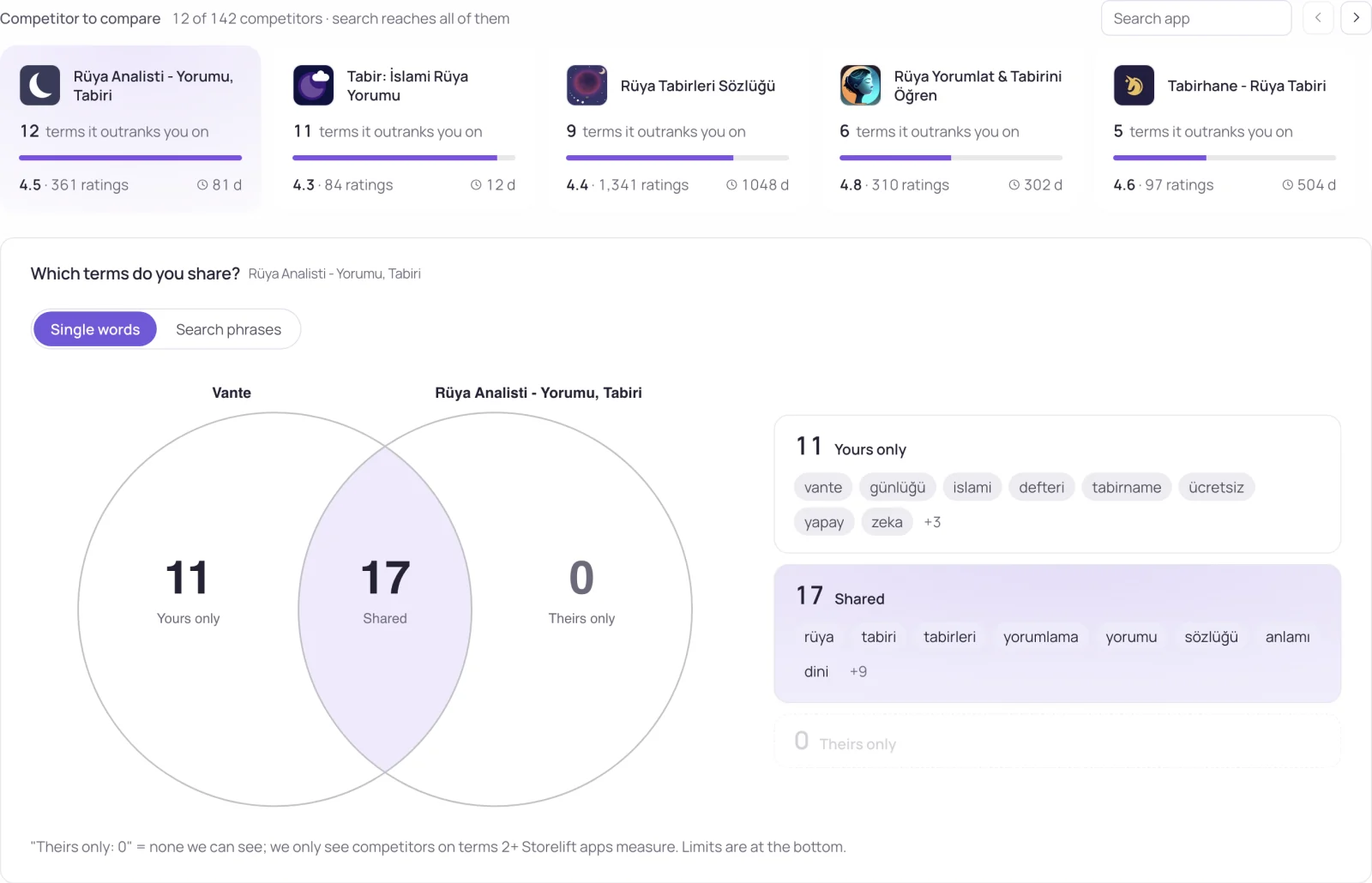
Title overlap. Whether the competing apps already use the term in their names. It shows text overlap; it does not establish why the publisher chose the title or why the app ranks.
Keep difficulty, demand, your own rank and any install or revenue figure separate. Each describes a different part of the decision and can have a different observation date or availability state.
Compare candidates without turning the score into a promise
Read the 0–100 difficulty score as a comparison aid for the observed keyword and storefront. It is not a calibrated probability, a forecast of time needed to rank or a requirement your app must meet.
Check the competing apps and rating counts alongside the score. A large rating count describes an observed app; it does not establish that count as a threshold or explain why the app ranks.
| Observation | Use it to | Keep in mind |
|---|---|---|
| Difficulty score | Compare relevant candidate terms | Read the country and observation date |
| Competing apps | Inspect the apps ahead of you | A rating count is not a required threshold |
| Title overlap | Compare the words visible in titles | Overlap does not prove intent or causation |
| Missing evidence | Identify what remains unknown | Missing is not an observed zero |
Hypothetical example: a score of 62 belongs to one term and storefront at a recorded time. Compare it with other relevant candidates and your own baseline; the number alone does not determine which term to choose.
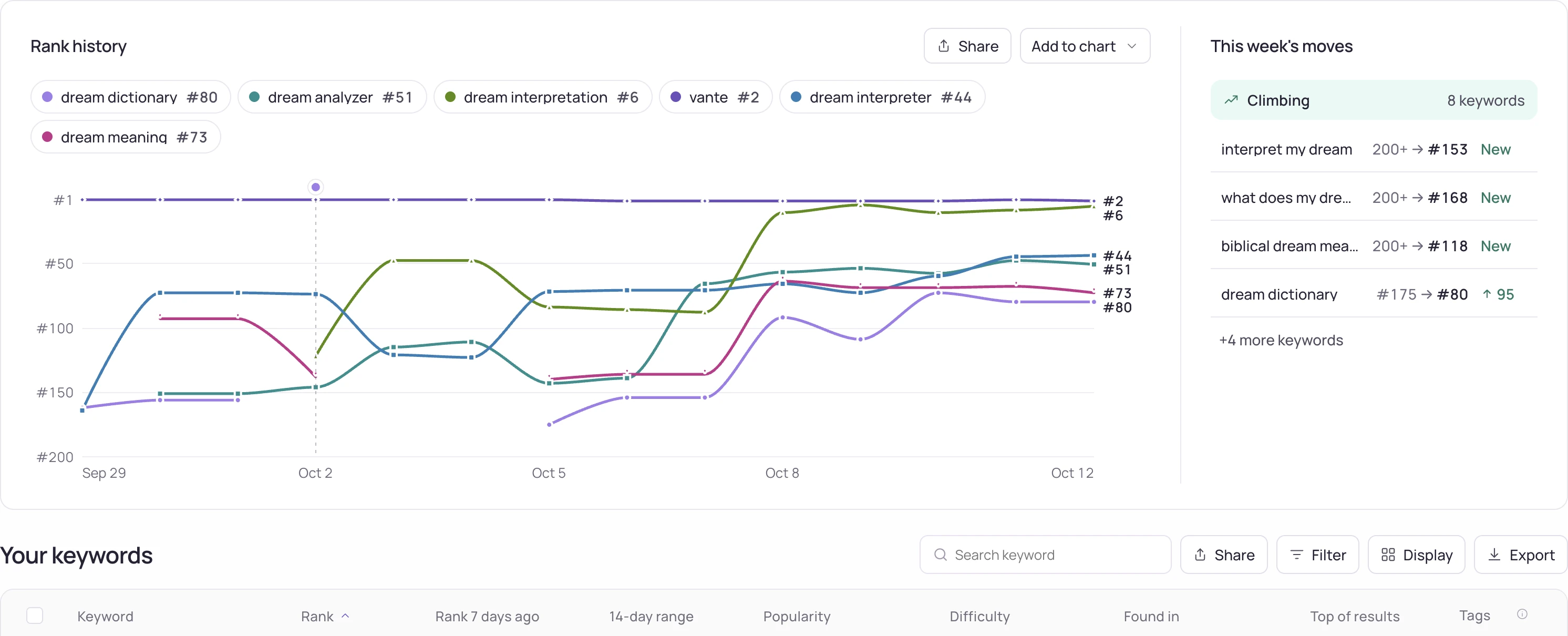
A score can be unavailable while a rank or popularity value is valid. Read each metric independently and preserve its stated measurement status.
Read dates and gaps
A retained metric keeps the date of its underlying observation. A newly displayed score does not turn older evidence into today’s measurement. When evidence is unavailable, compare the values that are verified and leave the gap visible.
What to read alongside the score
Inspect the competing apps and title overlap separately. They provide different context for the same keyword; one summary number does not establish the cause of a rank.
Read demand, popularity and any stated volume range in their own columns, with their country, date and scope. Missing popularity does not turn valid difficulty evidence into an error.
Frequently asked
What does keyword difficulty establish?
It supports comparison between candidate terms in the stated storefront and observation period. Read it beside relevance and the competing apps; it is not a ranking probability.
How should I read difficulty beside popularity?
Treat them as separate metrics. Check each value’s scope, date and availability; missing popularity does not mean zero demand or invalidate a verified difficulty reading.
Is a score of 62 good or bad?
The number alone does not decide. Compare relevant candidates, the competing apps and your current rank, keeping each observation’s date and country.
See this for your own app
Paste your store link, add your keywords. Rank, the apps above you and demand are measured every day.
Free plan: 1 app, 25 keywords in each of 2 storefronts, 30 days of history, no card, no end date. Pro is $20/mo.
Start free →